Federal Reserve Expected to Raise Interest Rates as Chair Warsh Faces Credibility Test
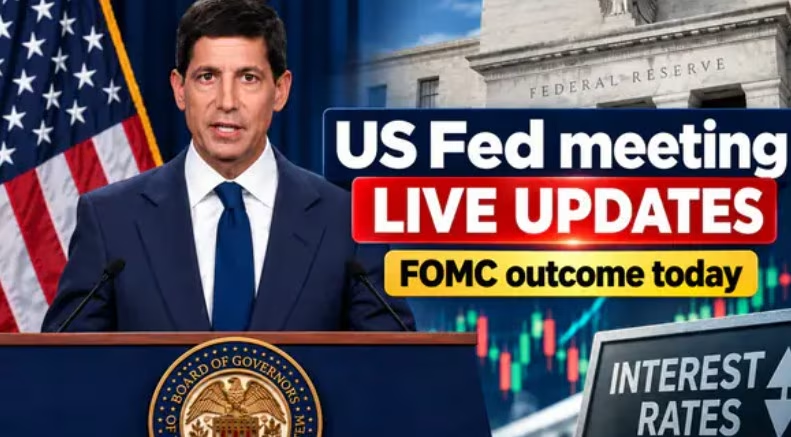
The Federal Reserve is expected to raise its benchmark interest rate by a quarter percentage point on Wednesday, the first increase in more than three years, as policymakers confront inflation that remains stubbornly above their 2 percent target. The decision will mark a critical test for Fed Chair Kevin Warsh, who was appointed by President Donald Trump and now must demonstrate the central bank’s independence from political pressure.
Markets have priced in roughly a 90 percent probability of a rate hike, according to the CME FedWatch tool, which would lift the federal funds rate from its current range of 3.50 percent to 3.75 percent . The Fed last raised rates in July 2023 during its battle against post-pandemic inflation.
The central bank has held rates steady since January 2026, waiting to assess the effects of energy price shocks and the pass-through of tariffs into consumer prices. That patience appears to have run out.
Inflation Stays Above Target
Consumer prices rose 3.4 percent in August from a year earlier, unchanged from July and still well above the Fed’s long-term 2 percent objective . The Fed’s preferred inflation gauge, the Personal Consumption Expenditures Price Index, stood at 3.7 percent in July and has remained above target for more than five years .
Core inflation, which excludes volatile food and energy prices, ran at 2.4 percent in August, but the monthly core rate of 0.3 percent exceeded consensus expectations. Fuel costs alone accounted for more than a third of the monthly headline increase .
Several forces are pushing prices higher. Brent crude has surged from the low $80s per barrel in August to above $100, driven by the conflict with Iran, the Houthi capture of Mokha, the effective closure of the Strait of Hormuz, and the shutdown of the Saudi East-West pipeline . Diesel prices have topped $6 per gallon for the first time.
Trump’s tariff policies have added another layer of price pressure. The administration levied new duties on Canada last week in response to Canadian retaliation against existing U.S. levies, marking the second escalation this year against the largest U.S. trading partner .
Warsh’s Credibility at Stake
Warsh set the stage for this moment at the Jackson Hole economic symposium in late August, when he said the Fed would have “work to do” if policymakers were not confident that underlying inflation was declining . Recent data, he noted, did not show that underlying trends had meaningfully improved .
The credibility dimension is specific to this chair. Trump has publicly demanded rate cuts and appointed a chairman he suggested was aligned with him, undercutting Warsh’s standing from his first day in office . Warsh’s own defense of his independence came during his initial congressional testimony, when he cited his failure to cut rates as evidence .
David Wessel, a senior fellow at the Brookings Institution, described the stakes in direct terms.
“This is the test. This is what comes with that job, and now he has to decide how to handle it,” Wessel said .
Wessel added that Warsh risks either disappointing financial markets or provoking Trump’s anger, depending on the decision .
White House officials have made their preference clear. Kevin Hassett, director of the National Economic Council, said on CNN that he and Trump believed there was no reason to raise rates at present, pointing to what he described as progress on inflation .
Market Positioning and Economic Forecasts
Traders assign a 93 percent probability to a quarter-point increase on Wednesday, according to Benzinga, which would lift the federal funds rate to 3.75 percent to 4.00 percent .
Economists are divided on what comes next. A median forecast compiled by MNI shows expectations for 50 basis points of increases, meaning one hike on Wednesday and another later in the year . Forecasts range from no increase at all to three quarter-point hikes.
Seven institutions including Bank of America, ANZ, RBC, Deutsche Bank, and Société Générale expect 75 basis points of tightening. JPMorgan, UBS, Barclays, and Wells Fargo are among those forecasting 50 basis points. Goldman Sachs, Citi, and ING expect only Wednesday’s quarter-point increase .
Jefferies holds the most dovish view, expecting no remaining hikes and a quarter-point cut in December .
Fed funds futures currently imply a benchmark rate near 4.2 percent by December and roughly 4.6 percent by September 2027. Traders are betting on a full percentage point of tightening, double what the economists surveyed expect .
“Markets are pricing close to 100bp of hikes in total, over the next year or so,” said Aditya Bhave, an economist at Bank of America. “We remain comfortable with our view that the Fed will raise rates a bit less (75bp), but much faster (by end-2026)” .
Bond Market Pressure
The bond market has already tightened financial conditions significantly without the Fed acting. The 10-year Treasury yield briefly reached 5.011 percent on Monday, its highest intraday level since July 2007, before retreating to around 4.96 percent . The 30-year yield sits at 5.35 percent, near a two-decade high .
Brij Khurana, a fixed-income portfolio manager at Wellington, said the level is psychologically important and warned the Fed could risk losing control of long-term rates, as happened in the U.K. in 2022, if it declines to raise rates .
“If rates don’t go up at this point, then the Fed loses a lot of credibility, and if you think higher rates are painful, wait until you see the kind of pain that you see if the Fed loses credibility,” said Chuck Failla, a certified financial planner and founder of Sovereign Financial Group .
Leon Ferdinand Bost, an analyst at Metzler, said Warsh’s decision to abandon forward guidance has left the Fed with little room to maneuver.
“Although we still believe that from a macroeconomic perspective, it is reasonable for the Fed to wait and observe how the inflation outlook evolves, the market is now pricing in a rate hike probability of over 90 percent,” Bost said. “Therefore, if the hike fails to materialize, the Fed and its chair would face a serious risk of reputational damage” .
Divided FOMC
The Fed’s rate-setting committee is not unified. At the July meeting, three FOMC members dissented, preferring to raise the policy rate by 25 basis points . Minutes from that gathering suggested that additional policy firming would likely be justified if inflation proved stubborn, fueled by forces including AI-driven demand, Middle East energy disruptions, or tariff pass-through costs .
Warsh dislikes the “dot plot” chart of rate projections and did not submit one of his own in June. The group was evenly divided in those projections, with nine of 19 officials feeling rates would need to rise by at least a quarter percentage point by the end of 2026, and nine anticipating they could remain where they are or drop .
Morgan Stanley economists adjusted their forecast to two increases for the year and cautioned that failing to act at this week’s gathering would undermine the Fed’s credibility .
The Fed will release its monetary policy statement at 2 p.m. EDT along with updated quarterly economic projections .
nn
Image Via: Mint
Related News
Hilary Duff Extends The Lucky Me Tour With Pittsburgh Arena Show Set for October 2027
Netflix Stock Falls in September as Analysts Point to YouTube Competition and Weak Engagement
Morgan Stanley Report Projects Hyperscaler AI Spending to Surpass $2 Trillion as Free Cash Flow Declines
Iran Downplays Direct Talks With US as Gulf Leaders Meet Trump on War Strategy
Jimmy Kimmel Criticizes Trump Press Ban With Remark on Melania Trump’s Separate Bedroom