AI Won’t Replace You – But This Type of Worker Will Be Gone by 2027
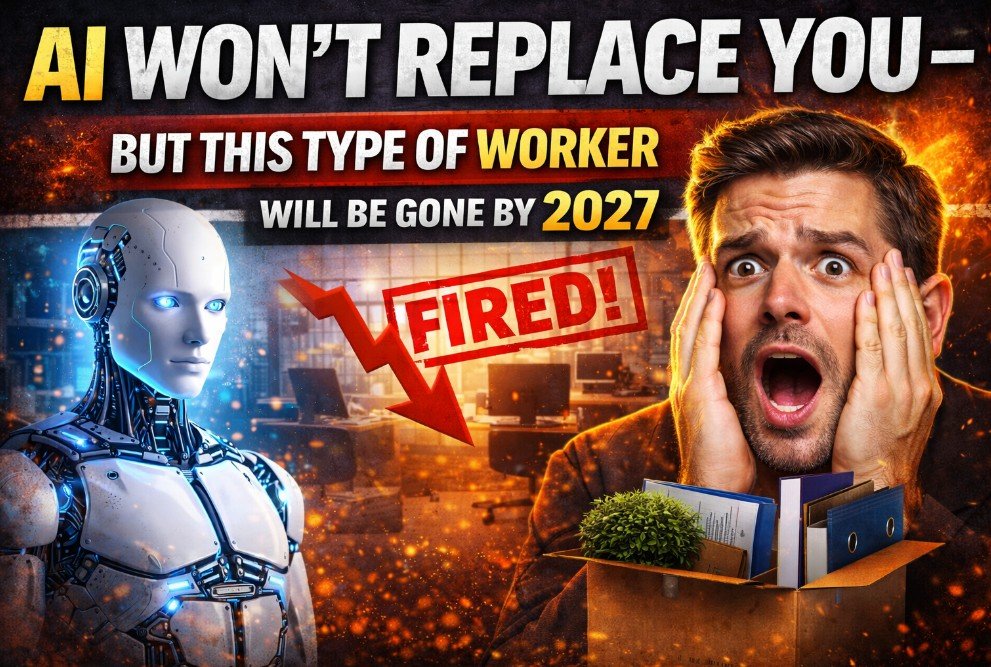
AI WON’T REPLACE YOU —
BUT THIS TYPE OF WORKER
WILL BE GONE BY 2027
The Definitive Guide to Who Survives, Who Thrives, and Who Gets Left Behind
Introduction: The Question Nobody Is Asking Correctly
The debate about artificial intelligence and employment has been dominated by the wrong question for years. “Will AI replace human workers?” generates headlines, stokes anxiety, and sells conference tickets, but it frames the phenomenon so broadly as to be nearly useless for any individual trying to understand what is actually happening to their career. AI is not a single force acting uniformly on a monolithic labor market. It is a collection of rapidly improving tools that interact with different types of work in dramatically different ways — accelerating some, augmenting others, substituting for some entirely, and leaving others largely untouched.
The right question is not whether AI will replace workers. The right question is: what specific type of professional behavior makes a worker replaceable — not by AI itself, but by a competitor who combines AI with the capabilities that machines cannot replicate? That reframing changes everything. It removes the threat of an invisible technological force acting on passive victims and replaces it with a concrete, navigable challenge: understand what makes professional value durable, and position yourself on the right side of that line.
This guide answers that challenge in full. We examine the specific characteristics — the behaviors, postures, skill compositions, and professional habits — that create vulnerability to displacement in the AI era. We identify with precision the types of workers who face acute risk by 2027, not because AI has become conscious and decided to eliminate them, but because the economic logic of AI augmentation makes their value proposition structurally untenable in the near term. And we map, with equal specificity, the characteristics that create genuine durability — the types of professional value that AI amplifies rather than replaces, and that the market is increasingly rewarding with exceptional compensation and career security.
The goal is not to frighten but to equip. The workers who understand this shift clearly, and respond with strategic intention rather than hope or denial, are in an extraordinary position to benefit from the most significant labor market reorganization in a generation. The workers who do not understand it — or understand it but choose not to respond — face a contraction in their professional value that will be uncomfortable to experience and costly to reverse.
Let us look at this clearly.
Section 1: How AI Actually Displaces Workers — The Mechanism Nobody Explains
1.1 Not Replacement — Compression
The dominant mental model of AI-driven job displacement imagines a robot (or a chatbot) that does exactly what a human does, at a lower cost, and therefore simply takes that human’s place. This model is not entirely wrong — some displacement does work this way — but it misses the more pervasive and more insidious mechanism through which AI eliminates roles in the near term.
The more common mechanism is compression: AI tools allow one person — or one small team — to produce the output that previously required a larger team, or that required more experienced (and more expensive) people than the work now warrants. The work is not automated away entirely. It is compressed. And the workers whose roles are made redundant by this compression are not those doing the most complex, judgment-intensive work — they are those doing the supporting work that AI now handles, and the middle-tier workers who were primarily valued for volume of output rather than quality of judgment.
Consider a marketing organization that previously needed six content writers to produce the volume of content its strategy required. AI writing tools, used effectively by two skilled content strategists, can now produce equivalent volume. The four writers who were not dismissed are not rendered unnecessary because AI wrote identical content. They are rendered unnecessary because the ratio of human creative direction to AI production has shifted, and the organization no longer needs as many people in the creative execution layer.
This compression dynamic is happening simultaneously across dozens of professional domains. Legal research that required armies of junior associates can now be performed by small teams with AI assistance. Data analysis that required data analyst pools can now be handled by smaller teams with AI-augmented tools. Customer support that required large staffed centers can now be managed by smaller teams overseeing sophisticated AI systems. In each case, the work is not gone — the workers doing a specific, replicable portion of it are gone.
1.2 The Two Axes of Vulnerability
Worker vulnerability to AI-driven displacement can be mapped across two axes that, taken together, predict risk with significant accuracy.
The first axis is task routineness: how much of the worker’s daily contribution consists of tasks that follow a definable pattern, apply known rules to known inputs, or produce outputs that can be specified in advance? Routine tasks — answering standard customer questions, formatting documents, generating standard reports, applying existing rules to new cases, producing first-draft content following established templates — are exactly the tasks that AI tools handle with increasing competence. The higher the proportion of a worker’s contribution that consists of routine tasks, the higher their vulnerability.
The second axis is judgment intensity: how much of the worker’s value comes from decisions that require synthesizing ambiguous information, navigating genuinely novel situations, applying contextual wisdom that cannot be fully specified in advance, or exercising the kind of human judgment that produces different outcomes in ways that matter? High judgment-intensity work is what AI augments rather than replaces — it is the work that defines the direction in which AI tools should be applied and evaluates whether the AI’s output is actually good.
Workers with high routine-task concentration and low judgment intensity are acutely vulnerable. Workers with high judgment intensity and low routine-task concentration are comparatively safe. Workers in the middle — the large majority of the workforce — face selective pressure: the routine portions of their work will be handled by AI or by AI-augmented colleagues, and what remains will consist increasingly of the judgment-intensive dimensions. Whether their role survives depends on whether those judgment-intensive dimensions are substantial enough to occupy a full-time role.
| 300M
Jobs exposed to automationpotential globally (IMF 2025) |
60%
Of current jobs have at least25% AI-automatable tasks |
12%
Of jobs may be fullyautomated by 2027 |
1.3 The Speed of the Transition
One of the most important and most underappreciated aspects of the current AI transition is its speed. Previous waves of automation — mechanization, computerization, internet-driven disruption — unfolded over decades. Workers had time to adapt, industries had time to develop new roles that absorbed displaced workers, and educational systems had time to produce graduates with relevant new skills. The current AI transition is moving faster.
The time between a new AI capability becoming technically feasible and that capability being deployed at scale in production systems has compressed dramatically. Large language models that could generate competent first-draft content were largely a research curiosity in 2021 and were embedded in the professional workflows of millions of knowledge workers by 2023. Code-completion AI tools followed a similar trajectory. The pace of deployment means that workers who are in routineness-exposed roles today have a shorter window to adapt than the historical precedent would suggest.
This is not a counsel of despair. The transition is creating new roles as it displaces others, and the workers who understand the direction of change early enough to adjust their skill profile and positioning have a significant advantage over those who respond reactively once the displacement is underway. The window for proactive adaptation is open. It is, however, narrowing.
⏰ Timing Matters: The workers who are adapting now — investing in the skills that create durability, repositioning from task execution to judgment and direction — are doing so from a position of strength while they still have the income, the time, and the employer relationships that make adaptation manageable. Those who wait until their role is actively threatened adapt under pressure, with fewer resources and less time. Early movers are not being alarmist — they are being strategic.
Section 2: The Worker Types Most at Risk by 2027
The following profiles describe worker types facing acute displacement pressure. They are defined not by industry or job title but by the behavioral and compositional patterns that create vulnerability. Many people will recognize elements of these profiles in their own work — which is precisely the point. Recognition is the first step toward the repositioning that prevents displacement.
| 1 | The Pure Task Executor
High volume, low judgment — AI’s sweetest target |
The pure task executor is the most immediately vulnerable worker in the AI era. Their professional value is defined almost entirely by their ability to reliably perform specific, well-defined tasks in volume: processing standard requests, generating templated content, applying known rules to incoming information, formatting and organizing data, responding to routine inquiries, or producing outputs that follow established patterns.
The defining characteristic of this profile is that the work is describable. If you can write a sufficiently detailed instruction set for how to do your job — a set of rules clear enough that a competent person with no prior knowledge of your field could follow them and produce acceptable output — then an AI system can almost certainly be trained or prompted to do the same. The professional value of a task executor is their speed and reliability at executing the describable. AI is faster and, in many contexts, more reliable at exactly this.
This profile is widespread in customer support, data entry and processing, basic content production, paralegal research, financial data processing, and a large proportion of administrative roles. It is also present — in varying concentrations — in virtually every profession that has developed operational maturity: the parts of the work that have been done so many times that they have become routine and formulaic. In medicine, it is the standard diagnostic flowchart. In law, it is the boilerplate contract clause. In engineering, it is the standard component specification. The common thread is that the task no longer requires the full capability of the professional doing it — and AI is now capable of replacing that reduced requirement.
⚠️ At Risk Because: The pure task executor’s value proposition is speed and reliability at describable tasks — exactly what AI systems are optimized to provide at a fraction of the cost. When the tasks are describable, they are also directable: any capable user with AI fluency can direct a tool to do them. This eliminates the scarcity premium the task executor relied upon.
The Specific Displacement Pattern
Pure task executors are typically not displaced through direct headcount reduction in the first instance. The initial displacement pattern is role stagnation: hiring freezes on the relevant role type as existing team members handle more volume with AI augmentation. The team that previously needed ten people now operates effectively with six. When attrition reduces the team naturally, the remaining positions are not backfilled. Over eighteen to thirty-six months, the headcount compresses without a dramatic announced layoff, and the workers who remain are those who have evolved their role toward judgment and direction.
The Adaptation Path
- Identify the judgment-intensive dimensions of your current work — the decisions that require contextual knowledge, the situations that do not fit the standard playbook, the outputs that require genuine evaluation rather than rule application — and deliberately expand your focus toward them.
- Develop AI tool proficiency specifically in the tools that are automating your routine tasks. Paradoxically, understanding the AI tools that threaten your current role is the fastest path to repositioning above them, as the person who directs and evaluates those tools rather than competing with them.
- Build domain expertise in the areas of your field that remain genuinely complex. Depth of specialist knowledge in the most ambiguous and contextual dimensions of your field creates value that cannot be compressed as easily.
| 2 | The Credential-Without-Competence Worker
The degree that no longer signals what it used to |
For decades, a professional credential — a degree, a certification, a professional qualification — functioned as a reliable proxy for competence in the eyes of employers. It indicated that the holder had invested time in structured learning, had passed some form of evaluation, and had been vetted by an institution that was presumed to have standards. Employers relied on this proxy because directly evaluating competence was expensive and time-consuming.
AI tools have changed this equation in two distinct ways. First, they have dramatically lowered the cost of direct competence assessment. Employers can now screen for actual skill through AI-administered technical assessments, portfolio review tools, and automated evaluation of work samples with a fraction of the human effort previously required. The credential as a shortcut for competence assessment becomes less necessary when assessment itself becomes cheap. Second, they have created a class of credential holders whose primary professional value was the execution of tasks that their credential qualified them to perform — and AI can now perform many of those tasks. The credential remains; the premium it commanded evaporates.
This profile is particularly acute among mid-career professionals in fields where the combination of degree credentials and years of experience have created compensation expectations that are no longer supported by their actual output relative to AI-augmented alternatives. The worker who has built a career on being the person with the credential and the domain familiarity — without developing the deep judgment, the relationship capital, or the leadership capability that would make them genuinely difficult to replace — is discovering that the credential story is no longer sufficient.
⚠️ At Risk Because: When the primary professional value proposition is ‘I have the credential and the familiarity with how we do things here,’ and AI tools can produce the same outputs at lower cost, the credential stops being a competitive moat. The moat was the difficulty of performing the task — not the difficulty of earning the credential.
The Specific Displacement Pattern
Credential-without-competence workers are often displaced through a more visible mechanism than pure task executors: the explicit reclassification of roles, where organizations redesign job descriptions to emphasize outcomes, judgment, and leadership rather than tasks and credentials, and then assess current role-holders against the new specification. Workers who cannot demonstrate the deeper competence the redesigned role requires find their position classified as redundant, regardless of their credential or seniority.
The Adaptation Path
- Conduct an honest audit of what your current role actually requires versus what you are actually capable of. Where is the gap between your credential level and your genuine judgment depth? That gap is your priority development target.
- Develop the capability to direct and evaluate AI tools in your domain — the person who can reliably judge whether AI output in their field is accurate, well-reasoned, and fit for purpose is performing a function the AI cannot perform for itself, and one that requires the domain competence the credential was supposed to signal.
- Build a portfolio of demonstrable outcomes rather than relying on the credential to speak for you. In a world where competence can be assessed directly, the professional with a track record of specific, measurable results is a more compelling candidate than one with equivalent credentials and vague experience descriptions.
| 3 | The Information Gatekeeper
Power built on access — eliminated when access becomes universal |
One of the most consistent patterns in economic history is that gatekeepers — those whose professional value is built primarily on controlling access to information, expertise, or resources that others need — face disruption whenever the cost of access to what they control decreases significantly. Librarians who controlled access to printed information faced disruption from the internet. Travel agents who controlled access to booking systems faced disruption from online booking platforms. Stock brokers who controlled access to market information faced disruption from online trading platforms.
AI represents the most powerful information access democratization in history. The ability to query vast bodies of knowledge, receive synthesized, contextualized answers at the level of a domain specialist, and apply that knowledge to specific problems — without requiring an intermediary who has spent years accumulating that knowledge — is now available to anyone with an internet connection. The professional whose core value was being the person who knew — the expert whom others consulted because they had the knowledge others lacked — faces a specific and acute form of disruption.
This profile appears in fields like consulting, legal advisory, financial advisory, medical second-opinion services, and any domain where the primary service delivered was access to expertise. The disruption is not that AI is always more accurate than the human expert. It is that AI provides good-enough access at near-zero cost, which changes the economics of when the human expert’s premium is justified. Routine consultations, standard advisory, and information-access interactions that previously warranted professional fees can increasingly be handled by AI tools. What remains — the truly complex, high-stakes, contextually nuanced engagements that require genuine judgment — is a smaller market that rewards genuine expertise more richly, but cannot sustain the same number of practitioners.
⚠️ At Risk Because: The scarcity premium of the information gatekeeper disappears when information access is democratized. The gatekeeper who has not developed the judgment, relationship, and contextual capability that goes beyond information access has nothing left to sell when the gate is removed.
The Adaptation Path
- Shift from being the person who provides information to being the person who synthesizes, contextualizes, and makes judgments about information in specific, high-stakes situations. The latter is what clients pay premium prices for in an information-abundant world.
- Develop deep expertise in the most complex, ambiguous, and contextually specific dimensions of your domain — the situations where standard answers break down and genuine professional judgment is required. These are the engagements that AI cannot handle and that clients will continue to seek human expertise for.
- Build the trust and relationship infrastructure that clients turn to for high-stakes decisions. Trust is built through track record, presence, and human relationship in ways that AI cannot replicate. Making trust your core asset repositions you above the information access layer.
| 4 | The Process Middleman
Coordination value eliminated by direct connection |
The process middleman is the worker whose primary value is coordination: connecting people, routing information, managing workflows, translating between departments, facilitating meetings, maintaining documentation that others need, or ensuring that processes designed by others are followed correctly. These are not trivial functions — organizational complexity genuinely requires them, and doing them well requires skill. But they are functions where the coordination is the product, and AI is becoming extraordinarily good at coordination.
AI-powered workflow tools, project management systems, document generation platforms, and meeting facilitation tools are rapidly absorbing the coordination layer of professional work. The project coordinator who manually tracks deliverables, chases status updates, and maintains project documentation is performing tasks that AI-integrated project management systems now handle automatically. The middle manager who primarily adds value by translating strategy into team-level priorities, relaying information upward and downward, and monitoring team output is performing functions that flat organizational structures supported by AI tools increasingly distribute.
The specific vulnerability of this profile is not that coordination is unimportant but that AI-assisted direct communication and automated workflow management eliminate the need for human intermediation in the coordination layer. When the AI system can track every project deliverable, flag dependencies, draft status updates, and surface the issues that require human attention, the human whose role was to manually perform these functions has their value proposition structurally undermined.
⚠️ At Risk Because: When AI handles coordination automatically, the human coordinator’s value must come from something that requires human judgment — conflict resolution, strategic prioritization, stakeholder trust, creative problem-solving — not from the coordination itself. Workers in this profile whose role is primarily coordination without significant judgment value are highly vulnerable.
The Adaptation Path
- Reposition from coordination to leadership: the ability to make judgment calls about priorities, to resolve conflicts between stakeholders, to identify when a process is not serving its purpose and needs redesign, and to build the trust that makes teams and organizations function — these are the irreducibly human dimensions of the coordinator’s work.
- Develop strategic communication capability: the process middleman who can do more than relay information — who can contextualize, persuade, and frame complex organizational dynamics for different audiences — is performing a judgment-intensive function that AI cannot replicate.
- Build expertise in organizational design and change management. The person who can evaluate whether current processes are fit for purpose and redesign them when they are not has a value proposition that is upstream of and more durable than one who simply executes existing processes.
| 5 | The Static-Skill Specialist
Expertise with an expiration date — and no renewal plan |
Technical expertise has always had some degree of depreciation — the skills that were cutting-edge a decade ago become standard over time, and the skills that were standard eventually become obsolete. This depreciation is not new. What is new is the speed of depreciation in the AI era and the specific mechanism by which it is occurring.
The static-skill specialist is a worker who has built deep competence in a specific technical or procedural domain and has, whether by choice or inertia, not maintained that competence as the field evolves. They are the expert in a specific programming language whose syntax is increasingly handled by AI code completion. They are the specialist in a specific software platform whose expertise was built before AI-augmented versions of that platform made many of their specialized tasks automated. They are the technical writer who learned their craft before AI writing tools became capable of producing competent first drafts. In each case, the specific expertise retains some value but has depreciated significantly as AI tools have absorbed the technically complex but procedurally describable portions of the work.
The vulnerability is compounded by the psychological difficulty of updating expertise that was hard-won. Professionals who spent years developing deep technical competence in a specific domain naturally resist the implication that AI tools can produce adequate substitutes. And they are not entirely wrong — the AI’s output is rarely as nuanced as the expert’s best work. But in many professional contexts, adequacy at dramatically lower cost defeats excellence at high cost, and the market premium for the expert’s superior output may be insufficient to sustain the role.
⚠️ At Risk Because: Static expertise depreciates faster than ever in the AI era, because AI tools absorb the learnable, describable portions of expert knowledge. The expert who is not continuously updating their expertise to stay ahead of what AI can do is in a race they do not realize they are losing.
The Adaptation Path
- Adopt continuous learning as a professional discipline rather than an occasional activity. Set aside regular time each week for deliberate skill development, focused specifically on the frontier of your field — what the most advanced practitioners are doing, what the AI tools are not yet capable of, what new capabilities are emerging that the field has not yet fully absorbed.
- Develop AI-complementary expertise: identify which dimensions of your technical specialty are most difficult for AI to replicate — the contextual judgment, the error identification, the creative synthesis, the stakeholder translation — and invest most heavily in those.
- Expand across the judgment layer of your domain. The technical expert who develops the strategic and advisory capabilities that allow them to direct their expertise toward high-value applications — rather than simply executing technical tasks — dramatically expands their durability.
| 6 | The Volume-Over-Value Producer
Rewarded for output quantity in a world that is drowning in quantity |
One of the most pervasive professional success strategies of the pre-AI era was the commitment to volume: producing more — more reports, more content, more analyses, more proposals, more client contacts, more of whatever the job required — than peers. Volume productivity was genuinely valuable when it was scarce and when producing more required proportionally more skilled human effort. Both of those conditions are eroding.
AI tools have made volume cheap. Content that previously required skilled writers producing at sustainable rates can now be produced in quantity by AI systems at a fraction of the cost. Reports that required analyst hours can be generated automatically. Proposals that required business development teams to invest significant time can be produced at scale. The professional whose primary competitive advantage was producing more than others — the journalist who wrote more stories, the analyst who produced more reports, the marketer who published more posts — faces a value proposition that has been structurally undermined.
This displacement is particularly acute in content production, where the volume of AI-generated content has exploded and continues to grow exponentially. The content producer who built their value on volume — who competed by being prolific — is now competing against tools that are more prolific than any human could be. What the volume-over-value producer often discovers too late is that the market they served valued their volume because good-enough content at high volume was what that market rewarded. When AI provides good-enough content at any volume, the human producing good-enough content at lower volume is no longer competitive.
⚠️ At Risk Because: Volume is no longer scarce. AI has made adequate output nearly free at any scale. The professional who has not developed a value proposition based on quality, judgment, originality, or specific audience relationship — something that AI volume cannot replicate — is competing against infinite supply.
The Adaptation Path
- Shift from volume to depth. In every domain where AI is flooding supply with adequate-quality volume, the scarcity premium is moving to exceptional quality, distinctive perspective, and genuine insight. Invest in producing less but better, and in developing the evaluative and curatorial capability to recognize what ‘better’ actually means in your domain.
- Develop a distinctive perspective or voice that is irreducibly yours. AI can produce competent generic content — it cannot produce content that reflects years of specific lived experience, developed aesthetic sensibility, or genuine expertise in a specific contextual domain. That distinctiveness is your moat.
- Reposition from producer to editor, director, or strategist. The professionals who are thriving in content-saturated fields are those directing AI tools toward specific strategic purposes, evaluating and curating the output, and ensuring it serves the specific relationship and trust goals that generic content cannot achieve.
| 7 | The Comfort-Zone Professional
The greatest risk factor is not your job description — it is your response to change |
The final worker type at risk is defined not by their role type, their industry, or their skill composition but by their psychological posture toward change. The comfort-zone professional has built a working life around the reliable replication of what has worked before — the approaches, tools, relationships, and personal work style that produced success in the past — without maintaining the curiosity, experimentation, and deliberate learning that would keep those approaches relevant as the environment changes.
This profile is dangerous precisely because it is so common and so comfortable. Professional success, by its nature, tends to reinforce the behaviors that produced it. The professional who succeeded by being diligent and technically competent in a specific domain receives signals — compensation, recognition, advancement — that validate that approach. The signals that the approach is becoming less sufficient are weaker and more ambiguous: a new AI tool that seems interesting but not yet urgent, an article about industry disruption that seems relevant but not immediately actionable, a younger colleague who has adopted different methods and seems to be doing well. These are the signals that the comfort-zone professional discounts as they focus on the familiar work that has always rewarded them.
The comfort-zone professional’s vulnerability is that they will not adapt until the adaptation is forced — and forced adaptation is almost always more expensive, less dignified, and less successful than proactive adaptation. The professional who begins experimenting with AI tools when they are optional, who updates their skills before the market requires it, and who seeks new challenges before their current ones become obsolete is investing in their future value from a position of strength. The one who waits until forced change arrives is adapting from a position of weakness, under time pressure, with fewer options.
⚠️ At Risk Because: In a period of rapid technological change, the refusal to adapt is itself a career strategy — just a losing one. The comfort-zone professional’s risk is not that AI will eliminate their specific role. It is that they will be standing still while the ground shifts under them, and discover too late that their professional value has silently and dramatically eroded.
The Adaptation Path
- Build experimentation into your professional routine deliberately. Commit to trying one new AI tool each month in a low-stakes context. Most experiments will not change your work substantially — but some will, and the habit of experimentation keeps you oriented toward the frontier.
- Seek honest external feedback on your professional relevance. Trusted colleagues, mentors outside your organization, and honest conversations with recruiters or clients can provide perspective on whether your skill profile and approach are keeping pace with what the market values.
- Develop a personal learning system — not a vague intention to ‘stay current’ but a specific, scheduled practice of engaging with new developments in your field. Treat it as non-negotiable professional maintenance, as important as client work.
Section 3: The Worker Types Who Will Thrive — The Other Side of the Analysis
Every analysis of who is at risk in a major labor market transition is incomplete without equal attention to who is best positioned to benefit. The AI era is not a zero-sum game where worker losses are the only story — it is creating genuine new value, new roles, and expanded opportunity for professionals who occupy the right side of the human-AI interface. Here are the worker profiles that the evidence suggests are best positioned for the coming years.
| A | The AI-Augmented Expert
Domain depth + AI fluency = an output capacity previously impossible |
The worker who combines genuine domain expertise with genuine AI fluency is the most distinctive professional profile of the AI era — and currently one of the rarest. This person does not compete with AI. They use AI as a capability multiplier that allows them to produce outputs that would have required a team, to explore analytical spaces that were previously too time-consuming, to serve clients at a quality and volume level that was not previously achievable. The result is a professional whose individual output capacity has expanded dramatically without a commensurate increase in cost, and whose value proposition to employers and clients has correspondingly grown.
The AI-augmented expert is not defined by mastery of any specific AI tool — specific tools change rapidly. They are defined by the practice of systematically integrating AI into their professional workflows, continuously experimenting with new tools as they emerge, developing a sophisticated understanding of what AI does and does not do well in their domain, and maintaining the domain depth that allows them to critically evaluate and direct AI output rather than accept it uncritically. The combination of those elements is genuinely powerful and genuinely scarce.
✅ Safe Because: The AI-augmented expert is not competing with AI — they are the human component of the human+AI system. Their domain expertise allows them to do what the AI cannot: exercise genuine judgment about whether the AI’s output is accurate, contextually appropriate, and fit for the specific purpose at hand. That judgment is the irreplaceable component of the system.
| B | The Complex Problem Architect
Judgment in genuinely ambiguous, high-stakes situations |
Some problems are well-defined, and AI is remarkably capable of solving them. Other problems are poorly defined — the situation is genuinely ambiguous, the relevant information is incomplete or contradictory, the right approach is not self-evident, and the consequences of getting it wrong are significant. The professional who can navigate these genuinely complex, high-stakes, poorly-defined problems is performing a function that AI tools can assist with but cannot substitute for, because the core capability required is not information processing — it is judgment.
Complex problem architects are found at the senior levels of consulting, strategy, law, medicine, and organizational leadership. They are also found in less obviously senior roles wherever the work consistently involves navigating genuinely novel situations: the startup founder whose product faces a regulatory challenge with no clear precedent, the engineer whose system is failing in a way that does not match any known failure mode, the therapist whose client presents a presentation that requires genuine clinical creativity. What these professionals share is a high proportion of their time spent on problems that require synthesizing ambiguous information and making decisions with material consequences under genuine uncertainty.
✅ Safe Because: Complex problem solving requires the synthesis of incomplete information, the exercise of contextual judgment, and accountability for consequences — all things that require a human in the loop. AI can support this work but cannot take responsibility for it, and cannot replicate the judgment that comes from years of navigating genuinely difficult situations.
| C | The Trust Anchor and Relationship Builder
High-stakes human connection that technology amplifies but cannot replace |
In every field and at every level of organizational life, there are professionals who are trusted in a way that is irreplaceable by any technology. This trust is not simply pleasantness or social grace — it is a specific, hard-won quality that comes from years of demonstrated reliability, honest communication, aligned interests, and genuine care for the outcomes of the people being served. It is the physician whose patients follow her recommendations not because she is the most technically advanced practitioner available but because they trust her judgment and her understanding of their specific situation. It is the advisor whose clients call him first when something important happens, not because he has the best database but because they know he will give them his honest assessment and stay with them through the difficulty.
This form of trust is structurally durable in the AI era for the same reason it has always been valuable: it cannot be manufactured, cannot be scaled cheaply, and cannot be replicated by any tool that the person did not choose to use. The professionals who build deep trust with the people they serve will always have a market. The disruption AI creates in their field will change the mix of services they provide and the tools they use to provide them, but it will not eliminate the fundamental human need for a trusted advisor, advocate, or partner in high-stakes situations.
✅ Safe Because: Trust of the kind that drives the most consequential professional relationships is earned through direct human experience over time. It requires presence, consistency, demonstrated care, and the willingness to deliver difficult truths honestly. AI can support trust-based relationships by handling the routine and administrative dimensions, but the trust itself is irreducibly human.
| D | The Creative Synthesizer
Connecting ideas across domains in ways that produce genuine originality |
AI is remarkably good at producing novel combinations within learned patterns. It is considerably less capable of the kind of creative synthesis that comes from genuine cross-domain insight — the unexpected connection between ideas from different fields that produces a genuinely new framework, product, or approach. The professional who moves fluently across disciplines, draws on a genuinely diverse range of experiences and knowledge sources, and synthesizes insights from those diverse inputs into original contributions is performing a creative function that AI augments rather than replaces.
This profile is found in the most innovative roles across every field: the researcher who draws on behavioral psychology to redesign healthcare delivery systems, the product designer who applies manufacturing engineering principles to software architecture, the strategist who applies ecological thinking to competitive dynamics. What these professionals share is the ability to see productive analogies and connections across domain boundaries that specialists within any single field would not notice, and to use those connections to generate genuinely novel solutions.
✅ Safe Because: Genuine cross-domain synthesis requires the lived experience of having deeply inhabited multiple domains, the curiosity to seek connections across them, and the creative judgment to know which connections are productive. AI can help explore the possibility space but cannot provide the human judgment about which possibilities are worth pursuing.
| E | The Human-AI Orchestrator
The conductor of the new knowledge work orchestra |
As AI tools proliferate and become embedded in professional workflows, a new role type has emerged that is both practically important and structurally durable: the professional who can effectively orchestrate multiple AI tools, human team members, and complex workflows toward a specific, high-quality outcome. This is not a purely technical role — it requires strategic judgment about how to decompose a complex goal into components that can be handled by different tools and people, quality evaluation capability across the outputs of those components, and the organizational and communication skills to keep the human-AI system aligned and productive.
The human-AI orchestrator is the professional who does not just use AI tools but builds AI-augmented workflows, identifies where human judgment must be injected into those workflows and at what quality thresholds, and continuously updates the system as the tools and requirements evolve. They are, in many ways, the organizational expression of the AI-augmented expert — except that their primary product is the system itself, rather than the individual output. As organizations increasingly depend on these systems for critical work, the professionals who can build and maintain them will be among the most valuable.
✅ Safe Because: The orchestration of complex human-AI systems requires strategic judgment, quality evaluation across multiple output types, and organizational leadership capability. These are irreducibly human contributions that become more valuable, not less, as the systems they orchestrate become more powerful and more consequential.
Section 4: The Evidence — What the Data Shows
4.1 Role Categories by Displacement Risk Level
| Risk Level | Role Categories | Primary Vulnerability Factor | Timeline |
| Critical (2025–2026) | Data entry, basic customer support, simple content creation, routine legal research, standard document processing | High task routineness, low judgment intensity, direct AI substitution possible | Active now |
| High (2026–2027) | Mid-tier content production, junior analyst roles, basic consulting, template-driven design, standard financial reporting | Compression: fewer humans needed per unit of output | 12–24 months |
| Medium (2027–2029) | Specialized advisory in mature domains, project coordination, middle management without strategic function, routine clinical assessment | Partial compression: judgment dimensions retain value, coordination does not | 24–48 months |
| Low (Durable) | Complex problem solving, trust-based advisory, creative synthesis, AI system design and oversight, human leadership | Requires judgment, contextual expertise, or human trust that AI cannot replicate | Structurally durable |
| Growing (AI-Era Premiums) | AI system development, human-AI workflow design, AI quality assurance, new domain synthesis, AI ethics and governance | New demand created by AI deployment | Expanding now |
4.2 Industry-Level Displacement Patterns
Displacement risk is not evenly distributed across industries. Several structural factors — the proportion of routine versus judgment-intensive work, the pace of AI tool adoption, the regulatory environment, and the strength of human relationship requirements — create significantly different risk profiles across sectors.
Financial services and insurance are experiencing rapid automation of the routine analysis, claims processing, and report generation that previously occupied large proportions of entry and mid-level roles. The premium roles in these industries are shifting toward complex financial judgment, client relationship management, and regulatory navigation — all functions that require human expertise and accountability.
Legal services are experiencing particularly significant disruption at the research and documentation layers, where AI tools now perform tasks that previously occupied armies of junior associates. The premium functions — complex litigation strategy, client counseling in genuinely ambiguous situations, negotiation and relationship management — remain human-intensive and are seeing compensation increases as the junior layer compresses.
Healthcare is experiencing a bifurcated pattern. Administrative and documentation functions — a historically significant source of healthcare employment — are being aggressively automated. Clinical care delivery is more resistant because of regulatory requirements, liability structures, and the irreducible value of human care in health contexts. But AI-assisted diagnostics, treatment planning, and patient monitoring are reshaping the clinical workflow in ways that are beginning to affect staffing models.
Marketing and content industries are experiencing what many practitioners describe as an existential restructuring. The volume content layer is rapidly being automated, and many organizations have dramatically reduced their content team headcounts while increasing total content output. What remains is strategy, brand voice curation, high-value relationship content, and the evaluation and direction of AI-generated content — a smaller number of higher-judgment roles.
| Industry | Most Vulnerable Functions | Most Durable Functions | Net Employment Trajectory |
| Financial Services | Data processing, routine analysis, standard reports | Complex advisory, risk judgment, client relationships | Declining volume, rising premium per role |
| Legal Services | Research, document review, boilerplate drafting | Litigation strategy, complex counseling, negotiation | Junior compression, senior premium expansion |
| Healthcare | Admin, documentation, standard diagnostics | Complex clinical judgment, patient relationships, research | Admin decline, clinical judgment premium growth |
| Marketing / Content | Volume content production, standard SEO, templated design | Brand strategy, audience relationships, creative direction | Sharp volume decline, strategy premium growth |
| Consulting | Standard framework application, benchmarking, basic analysis | Complex problem solving, senior advisory, change leadership | Junior model compression, senior premium growth |
| Technology | Basic coding, documentation, standard QA | Architecture, AI development, product judgment, security | Role transformation, strong net demand growth |
| Education | Lecture delivery, standard assessment, routine tutoring | Mentorship, complex facilitation, curriculum design | Delivery transformation, relationship role stability |
Section 5: The Strategic Response — From Vulnerable to Durable
5.1 The Audit You Need to Do This Week
The most valuable immediate action any professional can take after reading this analysis is a structured audit of their own vulnerability. This is not a comfortable exercise, but it is far more useful than general anxiety about AI disruption without the specificity to act on it.
The audit has four dimensions. First, task composition: what proportion of your typical working week is occupied by tasks that are describable, pattern-following, and in principle directable to an AI system? Be honest. If you spend significant time on routine reporting, standard correspondence, template-driven document production, or repeatable analytical processes, that proportion represents your current vulnerability exposure. Second, judgment intensity: for the portions of your work that you believe require genuine judgment, stress-test that belief by asking whether the judgment could be codified into a decision tree or a detailed prompt. If it could, it is more describable — and more vulnerable — than it feels.
Third, uniqueness of relationship: what proportion of the value you deliver to your organization or clients is based on who you specifically are — your particular accumulated expertise, your specific relationship history, your distinctive perspective — rather than on the role you occupy? Value that is attached to you as an individual is more durable than value that is attached to the role you happen to be filling. Fourth, learning trajectory: is the gap between what AI can do in your domain and what you can do growing, stable, or shrinking? If it is shrinking — if the things that distinguish your work from what AI can produce are getting smaller over time — that is a trajectory that deserves urgent attention.
5.2 The Three Moves That Build Durability
Move 1: Develop Your AI Fluency to Director Level
The most universal durability-building move is developing genuine, operational AI fluency — not awareness, not occasional use, but the kind of working fluency that allows you to integrate AI tools systematically into your professional workflows and direct them toward high-quality outputs in your specific domain. The professional who knows how to use AI tools to produce genuinely good work in their field, who can critically evaluate AI output against domain standards, and who continuously updates their AI capabilities as tools evolve is positioned above the AI layer rather than beneath it.
Director-level AI fluency means more than using the most popular tool for the most obvious task. It means developing workflows that leverage multiple tools in combination for complex outputs. It means building domain-specific prompting strategies that reliably produce high-quality results in your specific context. It means understanding enough about how AI tools work — their capabilities, their failure modes, their biases — to know when to trust their output and when to be skeptical.
Move 2: Deepen Into the Judgment Layer of Your Field
Every professional domain has a judgment layer — the portion of the work that requires synthesizing ambiguous information, navigating genuinely novel situations, and making decisions that have material consequences under genuine uncertainty. For most professionals, the judgment layer is not where they spend most of their time — it is surrounded by a much larger layer of routine and procedural work. The strategic move is to reduce time in the routine layer (by delegating, automating, or AI-augmenting it) and increase time in the judgment layer.
This is not simply a matter of preference or aspiration. It requires investing in the domain knowledge, the analytical frameworks, and the decision-making capabilities that make genuine judgment possible. Judgment is not an innate quality — it is developed through deliberate engagement with complex problems, critical reflection on outcomes, and exposure to the perspectives of practitioners who are more experienced. Seeking out the most complex, ambiguous, high-stakes work in your domain — even before you feel fully prepared for it — is the fastest path to developing the judgment depth that makes you durable.
Move 3: Build the Relationship Capital That Compounds Over Time
Professional relationships — genuine, trust-based connections with colleagues, clients, mentors, and collaborators who know your work directly — are among the most durable forms of professional value in any environment, and particularly durable in the AI era because they are structurally resistant to automation. The client who has worked with you through difficult situations and has direct experience of your judgment under pressure has a relationship with you that no AI tool can replicate or substitute for.
Building this relationship capital requires consistent investment over time: delivering well on commitments, being honest in assessments even when honesty is uncomfortable, showing up for the people in your professional network when they need something, and maintaining connections over years rather than only when you need something from them. These are not new principles. But they are principles whose return on investment has increased in an environment where the transactional, task-execution dimensions of professional value are being automated.
💡 Strategic Clarity: The professionals who emerge from the AI transition with expanded opportunity rather than compressed value are not those who resist the technology or those who surrender to it uncritically. They are those who deliberately position themselves at the interface: using AI to amplify their capability while continuously investing in the human dimensions of their value — judgment, relationships, creative synthesis — that AI makes more, not less, necessary.
5.3 The Mindset Shift That Precedes All Action
Underlying all of the strategic moves described above is a fundamental mindset shift that is easy to describe and difficult to execute: from thinking of your professional value as residing in what you know and what tasks you can perform, to thinking of it as residing in what you can make happen — the outcomes, decisions, relationships, and systems you can create that would not exist or would not function as well without you.
The professional who defines their value by what they know is vulnerable when AI tools know more, or when their specific knowledge becomes accessible to anyone with the right prompt. The professional who defines their value by what they can make happen — the complex problem solved, the client served through a difficult situation, the system designed and implemented, the organization navigated through uncertainty — is defining their value in terms that are not replicable by any tool, however capable.
This is not a small shift. It requires honesty about what you are actually contributing versus what you are occupying time doing. It requires the willingness to confront the parts of your current role that are genuinely vulnerable and to act on that confrontation before the market acts for you. And it requires the courage to invest in your own development in ways that are uncertain and uncomfortable, in service of a future that is still being written.
It is, in other words, exactly the kind of judgment under genuine uncertainty that defines the professional types who will thrive. Which suggests that the capacity for this mindset shift is itself evidence of durability.
Conclusion: The Honest Message
The title of this guide makes a claim that deserves to be unpacked honestly at the end. AI, in a literal sense, will replace some workers — directly, by performing tasks that humans previously performed exclusively. But the more important and more widespread dynamic is not direct replacement. It is the reordering of professional value that AI creates: elevating the premium on judgment, creativity, trust, and synthesis while compressing the premium on routine execution, information access, and volume production.
The workers who will be gone by 2027 are not those who were replaced by robots. They are those who were working in roles where their value was concentrated in the layers that AI has made cheap, and who did not reposition before the market repriced their contribution. Some of them saw the shift coming and chose not to respond. Some of them did not see it because they were not looking. A few of them had no realistic path to reposition given their circumstances, and their situation deserves compassion rather than criticism.
The majority of the people reading this guide are in none of those situations. They are professionals with the capacity to understand this shift, with the time and resources to invest in adaptation, and with careers long enough to make that investment worthwhile. For them, the honest message is this: the AI transition is the most significant labor market opportunity of their careers. The professionals who respond to it with strategic intentionality — who develop their AI fluency, deepen into their judgment layer, and build the relationship capital that compounds over time — are not trying to survive a disruption. They are positioning to thrive in the environment the disruption is creating.
That environment will reward different things than the one that preceded it. It will reward judgment over knowledge, synthesis over execution, trust over transaction, and human creativity over human volume. For professionals willing to invest in those qualities, the transition is not a threat to navigate. It is an invitation to become more valuable than the system they are leaving behind would have allowed.
The question is not whether to respond. The question is how quickly.
AI Won’t Replace You — But This Type of Worker Will Be Gone by 2027
A Definitive Guide for the Modern Professional
─── End of Report ───
Related News

Before You Make Another Career Move, Ask Yourself These 10 Questions

The Difference Between Having a Job and Building a Career Is Bigger Than You Think

You Don’t Need Another Certificate—You May Need to Use Your Skills Differently

If Your Workday Feels Like Groundhog Day, These 8 Career Changes Could Help

The Jobs You’re Qualified for Might Not Be the Jobs You’re Searching For