How to advance your career in 2026

The professional world of 2026 looks fundamentally different from what it did just a few years ago. Artificial intelligence has moved from a buzzword on conference slides to an embedded layer of everyday work. Remote and hybrid arrangements have matured from emergency accommodations into deliberate, strategic choices. And the shelf life of any single skill set has compressed dramatically, forcing professionals at every level to treat continuous learning not as a side project but as core to their job.
In this environment, advancing your career is no longer just about working harder or being the most experienced person in the room. It demands a clear-eyed strategy: knowing which skills to build, which relationships to cultivate, how to position yourself in a market reshaped by automation, and how to lead in ways that machines simply cannot replicate. This article walks you through exactly that — a detailed, actionable roadmap for meaningful career growth in 2026 and beyond.
Contents
- 01 — Understanding the 2026 Career Landscape
- 02 — Building an AI-Augmented Skill Set
- 03 — Strategic Networking in the Digital Age
- 04 — Personal Branding That Actually Works
- 05 — Navigating Remote and Hybrid Work Effectively
- 06 — Developing Leadership and Emotional Intelligence
- 07 — Managing Your Career Like a Portfolio
- 08 — Negotiating Your Worth With Confidence
- 09 — Mental Resilience as a Career Asset
- 10 — Designing Your Five-Year Vision
Understanding the 2026 Career Landscape
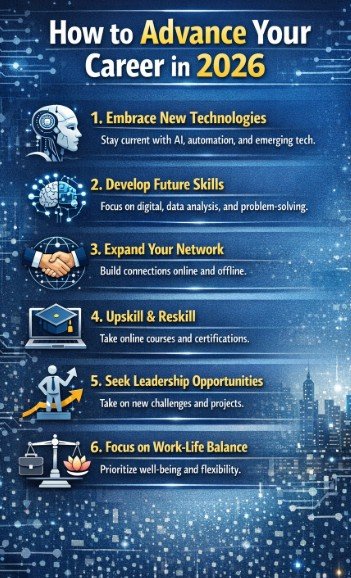
Before mapping out where you want to go, it pays to be honest about the terrain. The labor market of 2026 is defined by three powerful forces working simultaneously: automation, globalization of talent, and the splintering of traditional career paths.
Automation Is Reshaping — Not Just Replacing — Jobs
Contrary to the more alarmist predictions of the early 2020s, AI and automation have not wiped out white-collar work wholesale. Instead, they have redistributed it. Repetitive analytical tasks — data entry, basic report generation, templated communication, scheduling — are increasingly handled by software. What remains, and what is growing in value, is work that requires contextual judgment, genuine creativity, stakeholder navigation, and ethical reasoning. The professionals advancing fastest in 2026 are not those who resist this shift, but those who have positioned themselves as the human layer on top of powerful tools.
The Global Talent Pool Is Now Your Competition
Remote work has permanently expanded the competitive field. A marketing manager in Chicago is no longer competing only with others in Chicago — they are competing with skilled professionals across the world. This cuts both ways: it also expands opportunity. If you develop a distinctive specialty, your potential employers are no longer limited by geography. But it means generic competence — being reliably good at a broadly defined role — is less defensible than it once was. The strategic response is to develop depth, not just breadth.
The Rise of Non-Linear Careers
The old model of climbing a single ladder within a single company for thirty years has given way to something more complex and, arguably, more interesting. Professionals today are weaving together full-time roles, consulting engagements, course creation, advisory work, and entrepreneurial projects. This non-linearity can feel disorienting, but it also creates remarkable leverage. Each experience compounds your value, and the skills you develop in one context translate into unexpected advantages in another.
“The most valuable professionals in 2026 are not the ones who are hardest to replace — they are the ones who are hardest to fully describe on a job posting.”
Building an AI-Augmented Skill Set
The most consequential professional decision you can make right now is how you relate to AI tools. Dismissing them as hype — or, conversely, outsourcing your thinking to them entirely — are both losing positions. The professionals who are advancing are those who have developed a third way: deliberate, skilled collaboration with AI systems.
Learn to Prompt, Direct, and Evaluate AI Output
Prompt engineering has moved from a niche skill associated with software developers into a broadly applicable professional competency. Whether you work in finance, law, healthcare, or communications, knowing how to give AI systems precise, well-structured instructions — and critically evaluate what they produce — has become as fundamental as knowing how to run a search or write a professional email. Invest time here; the returns are immediate and compounding.
Identify the Tasks AI Does Poorly in Your Field
Rather than asking “what can AI do?”, the more strategic question is “what can AI not do well in my specific field?” These gaps define where your human value is concentrated. Nuanced client relationships, ethical judgment calls, creative conceptual work that requires real-world context, political navigation inside organizations — these remain stubbornly human domains. Map them in your own work, and lean in.
Technical Literacy Is Now Baseline, Not Advanced
You do not need to become a software engineer, but technical fluency — understanding how systems work, being comfortable with data, knowing enough about APIs to have a meaningful conversation with developers — has migrated from “nice to have” to the baseline expectation for most mid-to-senior roles. Even professionals in traditionally non-technical fields like HR, sales, and operations are finding that technical literacy accelerates their influence and their compensation.
Action StepAudit your current workflow this week. Identify five tasks you perform regularly that could be meaningfully accelerated by AI tools. Then spend one focused hour learning how to apply an AI assistant to each of them. Track time saved over the next month.
The Human Skills That Will Never Be Automated
Alongside technical fluency, invest heavily in the capabilities that remain immune to automation: deep listening, persuasion, mentorship, ethical reasoning, and the ability to synthesize information from radically different domains into a coherent point of view. These soft skills — a somewhat unfortunate label for things that are extraordinarily difficult to develop — are becoming the scarcest, most valuable commodity in the workforce.
Strategic Networking in the Digital Age
Networking has always been important. But in 2026, it has transformed in both its mechanics and its meaning. The old-school model of collecting business cards at conferences has been supplemented — and in many cases surpassed — by relationship-building that happens online, asynchronously, and across professional communities that exist entirely in digital spaces.
Build a Network, Not a Contact List
The distinction matters enormously. A contact list is a database of people you have met. A network is a web of reciprocal relationships where value flows in multiple directions. The shift from one to the other requires a fundamental change in orientation: from “what can this person do for me?” to “how can I consistently add value to the people I want to be connected with?” Over time, this generosity of spirit becomes one of your most powerful professional assets.
Leverage LinkedIn Thoughtfully
LinkedIn remains the dominant professional platform, but it has evolved considerably. Generic connection requests and mass-produced posts generate little traction. What works in 2026 is genuine expertise sharing — substantive posts, thoughtful comments on others’ work, and direct messages that demonstrate you have actually engaged with the recipient’s ideas. Quality of engagement matters far more than frequency of posting. One post that teaches something genuinely useful will outperform twenty posts recycling conventional wisdom.
Invest in Niche Professional Communities
Some of the most valuable networking now happens in smaller, more focused communities — Slack groups, Discord servers, industry-specific forums, and cohort-based learning programs. These environments attract highly engaged practitioners and create the kind of repeated, low-stakes interaction that allows trust to develop naturally. Finding two or three communities where you can show up consistently and contribute meaningfully is more valuable than maintaining a shallow presence across ten platforms.
The Mentorship Equation in 2026
Both having mentors and being a mentor are career accelerants. Senior mentors provide perspective, open doors, and help you avoid costly mistakes. But the value of reverse mentorship — building relationships with younger professionals who are closer to emerging technologies, cultural shifts, and new ways of working — is increasingly recognized by leaders who want to remain relevant. Consider pursuing both directions simultaneously.
Personal Branding That Actually Works
Personal branding gets dismissed by some as vanity, and abused by others into hollow self-promotion. The truth is more useful: a well-crafted personal brand is simply a clear, consistent signal about who you are, what you are excellent at, and what it is like to work with you. In a market where hiring managers and clients are overwhelmed with options, a distinct professional identity is one of the most pragmatic investments you can make.
Define Your Professional Point of View
The most effective personal brands are built not on credentials but on perspective. What do you believe about your field that most people do not? What problems do you see that others are missing? What approach do you bring that produces consistently different results? Articulating this clearly — in your writing, your conversations, your work output — is what turns you from a skilled generalist into someone people specifically seek out.
Create Rather Than Only Consume
Publishing your thinking — whether through articles, short posts, talks, a podcast, or even a well-maintained presence in online discussions — compounds your visibility over time in a way that passive participation never does. The content does not need to be perfect or exhaustive. It needs to be genuinely useful, consistently yours, and published with enough regularity that people begin to associate your name with a particular domain of expertise.
Your Portfolio Is Your Proof
Credentials tell people what you have been certified to do. A portfolio shows them what you have actually done. In 2026, assembling evidence of your work — case studies, outcomes you have driven, projects you have led, problems you have solved — and making that evidence accessible is a powerful differentiator. Even in fields where confidentiality limits what you can share publicly, you can describe results, methodologies, and the thinking behind your decisions in ways that demonstrate genuine capability.
Navigating Remote and Hybrid Work Effectively
Five years after the mass experiment in remote work began, the hybrid model has stabilized as the default arrangement for most knowledge workers. But not all hybrid workers advance at the same rate. The ones who thrive have learned to navigate its specific dynamics — the visibility challenges, the communication norms, the shifting expectations around availability and output.
Visibility Without Presenteeism
In an office, a significant portion of professional visibility comes from being seen — arriving early, staying late, being present in high-traffic spaces. Remote and hybrid work strips away this ambient visibility, which creates both a challenge and an opportunity. The challenge is that out-of-sight can become out-of-mind. The opportunity is that you are forced to make your contributions explicit, which is ultimately more defensible and more transferable than impression management.
Strategies that work include sending brief, clear weekly summaries of your progress to relevant stakeholders, being proactively communicative about what you are working on and what you need, volunteering for cross-team projects that give you exposure to different parts of the organization, and showing up reliably and engaged in the meetings that matter most.
Asynchronous Communication as a Competitive Skill
The ability to communicate clearly and completely in writing — without the ability to clarify in real time — has become a distinct professional advantage. People who write well, think structurally, and can convey context, reasoning, and a clear next step in a single message are far more effective in distributed organizations than those who rely on improvisation in meetings. Invest in your written communication. It pays dividends in every direction.
Pro InsightWhen in a hybrid arrangement, treat your in-office days as high-value relationship investment time — prioritize conversations, casual connection, and collaborative work. Reserve deep-focus, independent work for remote days. This intentionality signals maturity and earns autonomy.
Developing Leadership and Emotional Intelligence
Leadership has always been a distinguishing factor between those who hold individual contributor roles and those who grow into broader influence. But what constitutes effective leadership is shifting. Command-and-control styles that once passed for management are increasingly ineffective with a workforce that is better educated, more mobile, and more skeptical of authority than previous generations. The leaders advancing most rapidly in 2026 combine strategic clarity with high emotional intelligence and an authentic capacity to develop the people around them.
Lead Without a Title
You do not need formal authority to begin demonstrating leadership. Taking ownership of ambiguous problems, bringing people together around a shared goal, communicating a clear point of view in meetings, mentoring junior colleagues, and consistently delivering on your commitments are all forms of leadership that get noticed. The most effective path to formal leadership is informal leadership practiced consistently over time.
Emotional Intelligence Is a Measurable Skill
Emotional intelligence — the capacity to perceive your own emotions accurately, manage them effectively, understand others’ emotional states, and use that understanding to navigate relationships — is not a fixed trait. It is a learnable skill, and organizations in 2026 are increasingly explicit about valuing it. Invest in developing self-awareness through reflection, feedback, and coaching. Practice active listening as a discipline. Get comfortable with difficult conversations. The professionals who can hold complexity, navigate conflict, and remain steady under pressure are the ones being promoted into senior roles.
Develop the Ability to Build and Sustain Trust
At its root, all leadership influence is built on trust. And trust is built through a simple, repetitive process: making commitments and keeping them, being honest about what you do and do not know, following through on your word in the small things as well as the large, and treating the people around you with consistent respect regardless of their level. This sounds straightforward because it is. It is rare in practice, which is exactly what makes it powerful.
Managing Your Career Like a Portfolio
The most sophisticated career strategy in 2026 is to think of your professional life not as a single track to optimize but as a portfolio of experiences, skills, relationships, and income streams to actively manage. This framing changes how you evaluate opportunities, how you invest your time, and how you measure progress.
Diversify Your Experience Deliberately
Just as a well-managed investment portfolio balances high-growth assets with stable ones, a well-managed career portfolio balances deep expertise in a core area with exploratory experiences that expand your range. This might mean volunteering for projects outside your main function, developing a side skill that complements your primary work, or taking a role in a different industry that challenges your assumptions about how work gets done. Breadth creates resilience; depth creates value. You need both.
Know the Difference Between a Plateau and a Foundation
Not every period of apparent stagnation is a problem. Sometimes what looks like a plateau is actually a period of consolidation — building mastery, institutional knowledge, and credibility that will compound into the next stage of growth. The diagnostic question is whether you are learning and being stretched. If yes, stay the course. If no — if you are performing the same tasks you mastered two years ago with no new challenges on the horizon — it is time to either expand the role or consider a change.
Build Multiple Income Streams Where Possible
An increasing number of professionals in 2026 supplement their primary employment income with consulting projects, digital products, teaching, writing, speaking, or investing. Beyond the financial benefit, these additional streams tend to deepen expertise, expand networks, and provide the kind of external market feedback that internal roles sometimes insulate you from. Even a modest consulting engagement on the side can sharpen your thinking and strengthen your negotiating position at your primary employer.
Negotiating Your Worth With Confidence
Most professionals leave significant compensation on the table over the course of their careers simply because they do not negotiate — or because they negotiate without preparation. In a market that is increasingly transparent about salary data and increasingly competitive for specialized talent, knowing how to negotiate effectively is one of the highest-return skills you can develop.
Know Your Market Value Before Any Negotiation
Preparation is the foundation of effective negotiation. Use tools like LinkedIn Salary, Glassdoor, Levels.fyi (for tech roles), and industry salary surveys to develop a clear picture of market rates for your role, experience level, and location. Talk to peers and recruiters. Build a number grounded in evidence, not intuition. This preparation does two things: it gives you a credible anchor for the conversation, and it shifts your internal framing from “asking for more” to “requesting what is market-appropriate.”
Negotiate the Full Package, Not Just the Salary
Base salary is only one component of professional compensation. Benefits, equity, bonus structures, professional development budgets, remote work flexibility, title, scope of responsibility, and promotion timelines are all negotiable elements. A lower base with strong equity upside, excellent benefits, and a clear path to promotion may be more valuable than a higher salary in a role with limited growth potential. Learn to evaluate and negotiate the complete picture.
Timing and Framing Matter Enormously
The best time to negotiate a raise is after a significant win — when you have just delivered a major project, exceeded a target, or been recognized publicly for strong performance. The framing that works is collaborative rather than adversarial: “Based on my contributions and what I am seeing in the market, I believe a compensation adjustment to X is appropriate” lands better than ultimatums or comparisons to colleagues. Come in with data, a specific number, and a calm, confident tone. Most managers respond far better to a well-prepared, direct request than to hints or emotional appeals.
Mental Resilience as a Career Asset
Career advancement in 2026 is not purely a strategic or technical challenge. It is, at significant points, a psychological one. Rejection, setbacks, organizational turbulence, failed projects, missed promotions — these are not exceptions to a successful career; they are features of one. How you metabolize difficulty, maintain forward momentum through uncertainty, and protect your capacity for sustained high performance matters as much as any hard skill you develop.
Build Systems, Not Just Willpower
Resilience is not primarily about gritting your teeth through adversity. It is about building the habits, routines, and support structures that make high performance sustainable over years, not just months. Sleep, exercise, strong relationships, regular recovery time, meaningful hobbies, and clear boundaries between work and non-work life are not indulgences — they are operational necessities for any professional who wants to perform at a high level for a long career.
Develop a Healthy Relationship With Failure
Every significant career advance requires taking risks that might not pay off. The professionals who advance fastest are not those who never fail — they are those who fail forward: extracting learning quickly, adjusting course without excessive self-criticism, and maintaining the confidence to attempt difficult things again. Cultivate what Carol Dweck famously called a growth mindset — the belief that your capabilities are expandable through effort, strategy, and learning from experience, rather than fixed and finite.
Protect Your Energy Strategically
Not all work is equally demanding, and not all demands on your time are equally valuable. Learning to say no — clearly and without guilt — to requests that do not align with your priorities is a form of professional discipline. So is protecting blocks of uninterrupted time for the deep, creative, strategic work that actually moves your career forward. In an environment of near-constant notification and always-on availability, the ability to focus deliberately is one of the most valuable and underrated skills a professional can develop.
Designing Your Five-Year Vision
All of the strategies in this guide become more powerful when they are oriented toward a clear destination. Not a rigid script that ignores the inevitable twists of a real career, but a compelling vision — vivid enough to guide daily decisions, flexible enough to accommodate the unexpected.
Ask the Right Questions First
Vision starts with clarity about what you genuinely want, which is harder to achieve than it sounds in a world full of external signals about what you should want. Separate the goals that reflect your real values and preferences from those that reflect social comparison, financial anxiety, or other people’s expectations. Ask yourself: What kind of work makes me lose track of time? What does a successful day feel like in my ideal role? What trade-offs am I genuinely willing to make? What does enough look like — not in terms of what others would consider enough, but what actually satisfies me?
Set Goals at Multiple Time Horizons
Effective career planning operates simultaneously at the long-range, medium-range, and immediate level. A five-year vision gives you direction. A twelve-month plan gives you a concrete set of milestones to work toward. A ninety-day sprint gives you the specific projects, skills, and relationships to focus on right now. Connecting these three horizons — understanding how your activities this quarter build toward where you want to be in five years — creates the kind of purposeful momentum that compounds powerfully over time.
Review and Revise Regularly
A career vision is a living document, not a locked contract. Build in a regular practice — quarterly or biannually — of reviewing your goals, assessing your progress, and updating your plan in light of what you have learned about yourself, your industry, and the opportunities available to you. The professionals who advance consistently are not those who had the most perfect plan at the outset, but those who were most rigorous about learning from experience and adjusting accordingly.
“A career without reflection is just a series of events. A career with reflection becomes a story you are actively writing.”
Final Thoughts: The One Thread That Connects Everything
Running through every section of this guide is a single, unifying idea: career advancement in 2026 is an active, intentional practice, not a passive consequence of showing up and doing adequate work. The landscape is too dynamic, the competition too broad, and the pace of change too rapid for drift to produce the results you want.
But intentionality does not mean anxiety. It does not mean hustling in all directions simultaneously or treating every interaction as a networking opportunity. It means bringing clarity, curiosity, and genuine effort to the work — building skills that matter, relationships based on real mutual value, and a professional identity grounded in what you actually do well and care about.
The professionals who look back on 2026 as a breakthrough year will not be those who had the best circumstances. They will be those who looked honestly at the landscape, decided what they wanted, made a plan, and had the discipline and resilience to follow through on it — not perfectly, but persistently.
That version of your career is entirely within reach. Start today.
Related News

Before You Make Another Career Move, Ask Yourself These 10 Questions

The Difference Between Having a Job and Building a Career Is Bigger Than You Think

You Don’t Need Another Certificate—You May Need to Use Your Skills Differently

If Your Workday Feels Like Groundhog Day, These 8 Career Changes Could Help

The Jobs You’re Qualified for Might Not Be the Jobs You’re Searching For